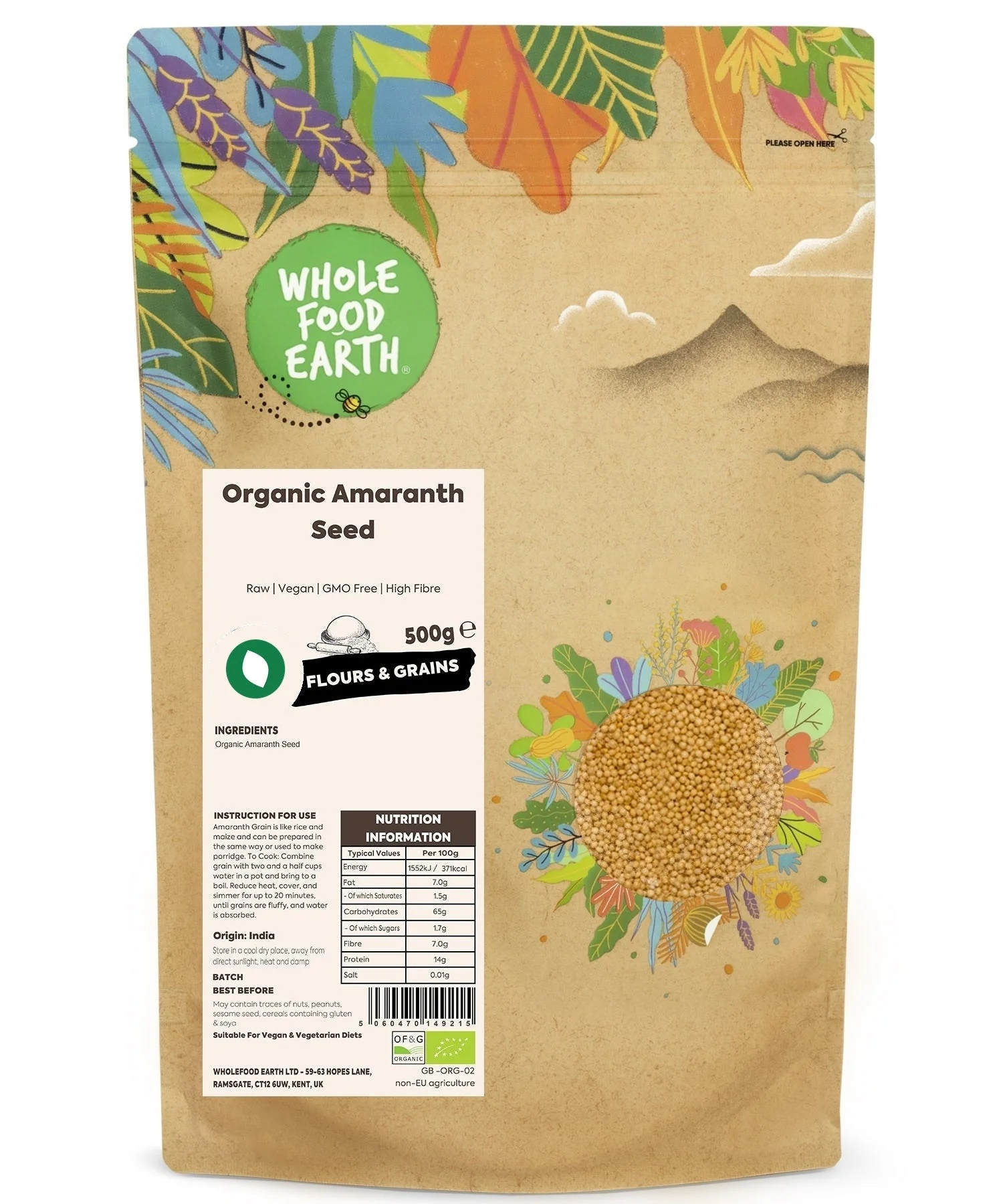


Organic Amaranth Seed
What is Organic Amaranth Seed?
The amaranth plant seeds have been valued for thousands of years, particularly by the indigenous cultures of Central America and Mexico.  
The root itself is also consumed as a root vegetable and has a rich mixture of minerals and nutrients.
Why Should I Get Organic Amaranth Seed?
Amaranth leaves contain a wide range of minerals, including a high concentration of calcium.
It is also a natural gluten-free substance, which means that for the millions of people suffering from Celiac disease or gluten intolerance, it provides a viable alternative as a grain source.
It Contains Lysine: Most grains like wheat are short on lysine, an amino acid, but that not the case for amaranth. This makes amaranth a complete protein, because it contains all the essential amino acids.
Instructions For Use:
Amaranth Seed is like rice and maize and can be prepared in the same way or used to make porridge. To Cook: Combine grain with two and a half cups water in a pot and bring to a boil. Reduce heat, cover, and simmer for up to 20 minutes, until grains are fluffy, and water is absorbed.
Storage Instruction: 
Store in a cool dry place, away from direct sunlight, heat and damp.
Packaging Details:
Eco Friendly 100% Recyclable Packaging. Re-sealable pouch for Long Lasting Freshness!
(Some Large sizes may have non resealable packaging)
What's In My Organic Amaranth Seed?
Ingredients: Organic Amaranth Seed
Allergen Information: Packed in an environment that handles nuts, peanuts, sesame, mustard, celery, soya and products containing gluten. For allergens see ingredients in bold.
Suitable for vegan & vegetarian diets
Country of Origin:  India
| Typical Values | Per 100g |
| Energy | 369kcal/1552kJ |
| Protein | 14 g |
| Fat | 7 g |
|  - Of Which Saturates | 1g |
| Carbohydrates | 59g |
|  - Of Which Sugars | 2g |
| Sodium | 0.01g |
| Fibre | 7g |
Product Information
Product Information
Shipping & Returns
Shipping & Returns
Description
What is Organic Amaranth Seed?
The amaranth plant seeds have been valued for thousands of years, particularly by the indigenous cultures of Central America and Mexico.  
The root itself is also consumed as a root vegetable and has a rich mixture of minerals and nutrients.
Why Should I Get Organic Amaranth Seed?
Amaranth leaves contain a wide range of minerals, including a high concentration of calcium.
It is also a natural gluten-free substance, which means that for the millions of people suffering from Celiac disease or gluten intolerance, it provides a viable alternative as a grain source.
It Contains Lysine: Most grains like wheat are short on lysine, an amino acid, but that not the case for amaranth. This makes amaranth a complete protein, because it contains all the essential amino acids.
Instructions For Use:
Amaranth Seed is like rice and maize and can be prepared in the same way or used to make porridge. To Cook: Combine grain with two and a half cups water in a pot and bring to a boil. Reduce heat, cover, and simmer for up to 20 minutes, until grains are fluffy, and water is absorbed.
Storage Instruction: 
Store in a cool dry place, away from direct sunlight, heat and damp.
Packaging Details:
Eco Friendly 100% Recyclable Packaging. Re-sealable pouch for Long Lasting Freshness!
(Some Large sizes may have non resealable packaging)
What's In My Organic Amaranth Seed?
Ingredients: Organic Amaranth Seed
Allergen Information: Packed in an environment that handles nuts, peanuts, sesame, mustard, celery, soya and products containing gluten. For allergens see ingredients in bold.
Suitable for vegan & vegetarian diets
Country of Origin:  India
| Typical Values | Per 100g |
| Energy | 369kcal/1552kJ |
| Protein | 14 g |
| Fat | 7 g |
|  - Of Which Saturates | 1g |
| Carbohydrates | 59g |
|  - Of Which Sugars | 2g |
| Sodium | 0.01g |
| Fibre | 7g |